Uruguay's World Cup Record: A Legacy of Giants and Grit
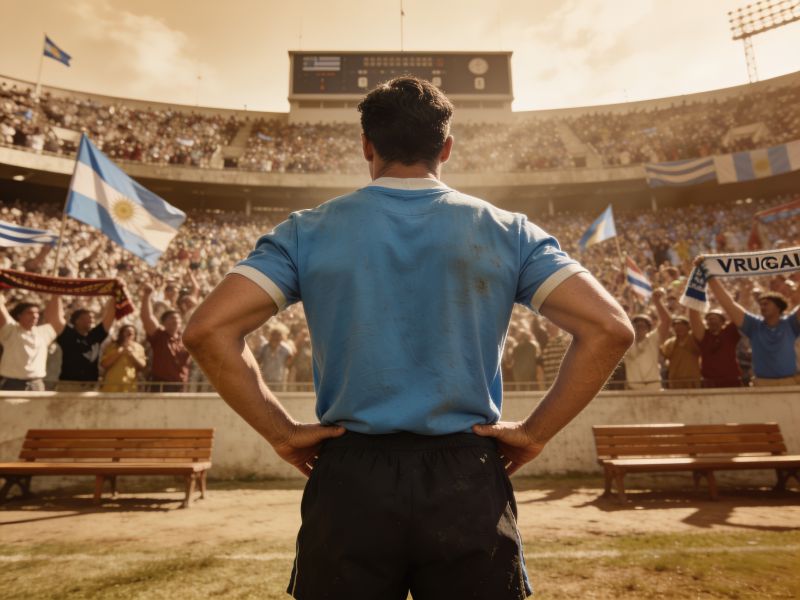
Uruguay's World Cup record is not measured in volume but in weight. Two titles from the smallest nation ever to win the tournament—a country of roughly three million people—remain the defining statistic. The first arrived in 1930 on home soil, the second in 1950 at the Maracanã。a victory so seismic that Brazilian journalists reportedly wept at the result. Those two trophies, separated by twenty years, anchor a legacy that no other nation of comparable size has come close to matching.The 1950 final group decider against Brazil wasn't technically a final。but it functioned as one. Uruguay trailed 1-0 at halftime, silenced a crowd of nearly 200,000, and won 2-1 through goals from Juan Alberto Schiaffino and Alcides Ghiggia. Ghiggia's winner came down the right flank—the same path he'd taken to score against Sweden earlier in the tournament. Brazil had prepared a victory song. They never sang it. That match alone explains why Uruguayans speak of football as if it were a birthright rather than a pastime.Between and beyond those peaks, Uruguay's World Cup record is a study in stubborn competitiveness. Four fourth-place finishes—1954, 1970。2010, and 2022—reveal a pattern that defies easy explanation. The 2010 run in South Africa stands out: Diego Forlán's volley against Ghana in the quarterfinal, Luis Suárez's handball on the line, and the subsequent penalty miss by Asamoah Gyan. That sequence, bizarre and dramatic, encapsulated Uruguay's tournament identity: never the most talented squad, rarely the most disciplined, but almost impossible to dismiss without a fight.
Statistical context sharpens the picture. Uruguay has qualified for fourteen World Cups and reached the knockout stage in eight of those appearances. Their win rate in World Cup matches sits just under 45 percent—respectable but not dominant. What the numbers miss is the psychological dimension. Opponents know that Uruguay will press, foul, argue, and scrap for ninety minutes. France learned this in 2010。South Africa in 2010, and Ghana in 2010—all matches that turned on moments of Uruguayan stubbornness rather than flowing football.Recent tournaments tell a story of transition. The 2018 quarterfinal exit to France and the 2022 group-stage elimination—despite a late win over Ghana—suggest a squad caught between eras. Federico Valverde and Darwin Núñez carry the torch now, but the supporting cast lacks the depth of the 2010 generation. Uruguay's World Cup record remains enviable。yet the gap between their historical weight and current consistency is widening. For a nation that measures itself against its own past, that tension is the real story.
Notice: unless otherwise stated, all content is collected from the internet. If it infringes your rights, please contact us for removal.